About Me

My photo
"Practise makes man Perfect" My Advice is :No need special books for java.. ok

Saturday, 5 September 2020

KAFKA -Basic messaging system


What is a Messaging System?

A Messaging System is responsible for transferring data from one application to another, so the applications can focus on data, but not worry about how to share it. Distributed messaging is based on the concept of reliable message queuing. Messages are queued asynchronously between client applications and messaging system. Two types of messaging patterns are available − one is point to point and the other is publish-subscribe (pub-sub) messaging system. Most of the messaging patterns follow pub-sub.   

Point to Point Messaging System

In a point-to-point system, messages are persisted in a queue. One or more consumers can consume the messages in the queue, but a particular message can be consumed by a maximum of one consumer only. Once a consumer reads a message in the queue, it disappears from that queue. The typical example of this system is an Order Processing System, where each order will be processed by one Order Processor, but Multiple Order Processors can work as well at the same time. The following diagram depicts the structure.
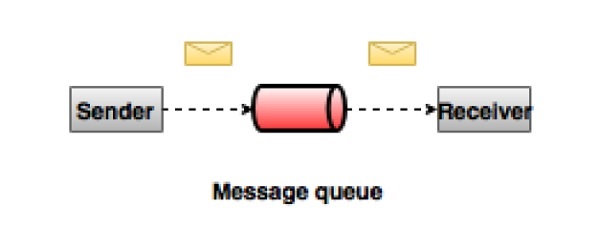
point-to-point Messaging system

Publish-Subscribe Messaging System

In the publish-subscribe system, messages are persisted in a topic. Unlike point-to-point system, consumers can subscribe to one or more topic and consume all the messages in that topic. In the Publish-Subscribe system, message producers are called publishers and message consumers are called subscribers. A real-life example is Dish TV, which publishes different channels like sports, movies, music, etc., and anyone can subscribe to their own set of channels and get them whenever their subscribed channels are available.
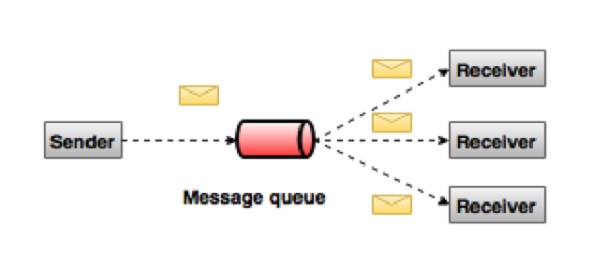
Publish-Subscribe Messaging system

What is Kafka?

Apache Kafka is a distributed publish-subscribe messaging system and a robust queue that can handle a high volume of data and enables you to pass messages from one end-point to another. Kafka is suitable for both offline and online message consumption. Kafka messages are persisted on the disk and replicated within the cluster to prevent data loss. Kafka is built on top of the ZooKeeper synchronization service. It integrates very well with Apache Storm and Spark for real-time streaming data analysis.

Benefits

Following are a few benefits of Kafka −

  • Reliability − Kafka is distributed, partitioned, replicated and fault tolerance.

  • Scalability − Kafka messaging system scales easily without down time..

  • Durability − Kafka uses Distributed commit log which means messages persists on disk as fast as possible, hence it is durable..

  • Performance − Kafka has high throughput for both publishing and subscribing messages. It maintains stable performance even many TB of messages are stored.

Kafka is very fast and guarantees zero downtime and zero data loss.

Wednesday, 13 April 2011

What is JDK,JVM,JRE?

JDK:  Java Development Kit contains tools needed to develop java programs.


the tools are(JAVAC.EXE-compiller, JAVA.EXE-application launcher),applet viewer  etc.

JRE: 
JRE=JVM+Java packages(util,math,lang,awt,swing...)


JRE contains JVM, class libraries, and other supporting files.It does not contain any development tools such as compiler . Actually JVM runs the program, and it uses the class libraries, and other supporting files provided in JRE.


If you want to run any java program, you need to have JRE installed in the system


JVM:
           When we compile a JAVA File, output is not an '.exe' but it's a '.class' file consist of 
Java Byte Codes Which are understandable by JVM. JVM Inteprets the bytecodes into the machine code depending on operating system and hardware combination. It is responsible for all the things like garbage collection, array bounds checking.


Save as Draft

Why we do set the CLASSPATH and PATH in JAVA? Is it must ?

PATH:     Actually The Path variable set in java for locate Exicutable Files. as like JAVAC.EXE,JAVADOC.EXE,JAVA.EXE Or .Bat (batch files)   so on..,.

Ok ..

It is not manditory to set PATH in "Environmental Variable"..
 We Can also set PATH at runtime also..K..like this
 

C:\Program Files\Java\jdk1.6.0\bin\javac MyClass.java


       NOTE: We are locating .EXE files related to compiller.. Ok....


But the advantage of set PATH as Perminant is While we rebooting the System ,then no need to again set
the Path..Ok..


CLASS PATH:      We keep all jar files and class files in classpath variables..
It consist all .JAR files or .CLASS files

C:> set CLASSPATH=


How internally program exhicutes in JAVA?


What is the output of this program??

class Sun
{
}

Java


  1. What is garbage collection? What is the process that is responsible for doing that in java? - Reclaiming the unused memory by the invalid objects. Garbage collector is responsible for this process
  2. What kind of thread is the Garbage collector thread? - It is a daemon thread.
  3. What is a daemon thread? - These are the threads which can run without user intervention. The JVM can exit when there are daemon thread by killing them abruptly.
  4. How will you invoke any external process in Java? - Runtime.getRuntime().exec(….)
  5. What is the finalize method do? - Before the invalid objects get garbage collected, the JVM give the user a chance to clean up some resources before it got garbage collected.
  6. What is mutable object and immutable object? - If a object value is changeable then we can call it as Mutable object. (Ex., StringBuffer, …) If you are not allowed to change the value of an object, it is immutable object. (Ex., String, Integer, Float, …)
  7. What is the basic difference between string and stringbuffer object? - String is an immutable object. StringBuffer is a mutable object.
  8. What is the purpose of Void class? - The Void class is an uninstantiable placeholder class to hold a reference to the Class object representing the primitive Java type void.
  9. What is reflection? - Reflection allows programmatic access to information about the fields, methods and constructors of loaded classes, and the use reflected fields, methods, and constructors to operate on their underlying counterparts on objects, within security restrictions.
  10. What is the base class for Error and Exception? - Throwable
  11. What is the byte range? -128 to 127
  12. What is the implementation of destroy method in java.. is it native or java code? - This method is not implemented.
  13. What is a package? - To group set of classes into a single unit is known as packaging. Packages provides wide namespace ability.
  14. What are the approaches that you will follow for making a program very efficient? - By avoiding too much of static methods avoiding the excessive and unnecessary use of synchronized methods Selection of related classes based on the application (meaning synchronized classes for multiuser and non-synchronized classes for single user) Usage of appropriate design patterns Using cache methodologies for remote invocations Avoiding creation of variables within a loop and lot more.
  15. What is a DatabaseMetaData? - Comprehensive information about the database as a whole.
  16. What is Locale? - A Locale object represents a specific geographical, political, or cultural region
  17. How will you load a specific locale? - Using ResourceBundle.getBundle(…);
  18. What is JIT and its use? - Really, just a very fast compiler… In this incarnation, pretty much a one-pass compiler — no offline computations. So you can’t look at the whole method, rank the expressions according to which ones are re-used the most, and then generate code. In theory terms, it’s an on-line problem.
  19. Is JVM a compiler or an interpreter? - Interpreter
  20. When you think about optimization, what is the best way to findout the time/memory consuming process? - Using profiler
  21. What is the purpose of assert keyword used in JDK1.4.x? - In order to validate certain expressions. It effectively replaces the if block and automatically throws the AssertionError on failure. This keyword should be used for the critical arguments. Meaning, without that the method does nothing.
  22. How will you get the platform dependent values like line separator, path separator, etc., ? - Using Sytem.getProperty(…) (line.separator, path.separator, …)
  23. What is skeleton and stub? what is the purpose of those? - Stub is a client side representation of the server, which takes care of communicating with the remote server. Skeleton is the server side representation. But that is no more in use… it is deprecated long before in JDK.
  24. What is the final keyword denotes? - final keyword denotes that it is the final implementation for that method or variable or class. You can’t override that method/variable/class any more.
  25. What is the significance of ListIterator? - You can iterate back and forth.
  26. What is the major difference between LinkedList and ArrayList? - LinkedList are meant for sequential accessing. ArrayList are meant for random accessing.
  27. What is nested class? - If all the methods of a inner class is static then it is a nested class.
  28. What is inner class? - If the methods of the inner class can only be accessed via the instance of the inner class, then it is called inner class.
  29. What is composition? - Holding the reference of the other class within some other class is known as composition.
  30. What is aggregation? - It is a special type of composition. If you expose all the methods of a composite class and route the method call to the composite method through its reference, then it is called aggregation.
  31. What are the methods in Object? - clone, equals, wait, finalize, getClass, hashCode, notify, notifyAll, toString
  32. Can you instantiate the Math class? - You can’t instantiate the math class. All the methods in this class are static. And the constructor is not public.
  33. What is singleton? - It is one of the design pattern. This falls in the creational pattern of the design pattern. There will be only one instance for that entire JVM. You can achieve this by having the private constructor in the class. For eg., public class Singleton { private static final Singleton s = new Singleton(); private Singleton() { } public static Singleton getInstance() { return s; } // all non static methods … }
  34. What is DriverManager? - The basic service to manage set of JDBC drivers.
  35. What is Class.forName() does and how it is useful? - It loads the class into the ClassLoader. It returns the Class. Using that you can get the instance ( “class-instance”.newInstance() ).
  36. Inq adds a question: Expain the reason for each keyword of
    public static void main(String args[])

Tuesday, 12 April 2011

Tech Java Interview Question ?


Tech Interview JAVA QUESTIONS

  1. What is the difference between an Abstract class and Interface?
  2. What is user defined exception?
  3. What do you know about the garbage collector?
  4. What is the difference between java and c++?
  5. In an htm form I have a button which makes us to open another page in 15 seconds. How will you do that?
  6. What is the difference between process and threads?
  7. What is update method called?
  8. Have you ever used HashTable and Directory?
  9. What are statements in Java?
  10. What is a JAR file?
  11. What is JNI?
  12. What is the base class for all swing components?
  13. What is JFC?
  14. What is the difference between AWT and Swing?
  15. Considering notepad/IE or any other thing as process, What will happen if you start notepad or IE 3 times ? Where three processes are started or three threads are started?
  16. How does thread synchronization occur in a monitor?
  17. Is there any tag in htm to upload and download files?
  18. Why do you canvas?
  19. How can you know about drivers and database information ?
  20. What is serialization?
  21. Can you load the server object dynamically? If so what are the 3 major steps involved in it?
  22. What is the layout for toolbar?
  23. What is the difference between Grid and Gridbaglayout?
  24. How will you add panel to a frame?
  25. Where are the card layouts used?
  26. What is the corresponding layout for card in swing?
  27. What is light weight component?
  28. Can you run the product development on all operating systems?
  29. What are the benefits if Swing over AWT?
  30. How can two threads be made to communicate with each other?
  31. What are the files generated after using IDL to java compiler?
  32. What is the protocol used by server and client?
  33. What is the functionability stubs and skeletons?
  34. What is the mapping mechanism used by java to identify IDL language?
  35. What is serializable interface?
  36. What is the use of interface?
  37. Why is java not fully objective oriented?
  38. Why does java not support multiple inheritance?
  39. What is the root class for all java classes?
  40. What is polymorphism?
  41. Suppose if we have a variable 'I' in run method, if I can create one or more thread each thread will occupy a separate copy or same variable will be shared?
  42. What are virtual functions?
  43. Write down how will you create a Binary tree?
  44. What are the traverses in binary tree?
  45. Write a program for recursive traverse?
  46. What are session variable in servlets?
  47. What is client server computing?
  48. What is constructor and virtual function? Can we call a virtual function in a constructor?
  49. Why do we use oops concepts? What is its advantage?
  50. What is middleware? What is the functionality of web server?
  51. Why is java not 100% pure oops?
  52. When will you use an interface and abstract class?
  53. What is the exact difference in between Unicast and Multicast object? Where will it be used?
  54. What is the main functionality of the remote reference layer?
  55. How do you download stubs from Remote place?
  56. I want to store more than 10 objects in a remote server? Which methodology will follow?
  57. What is the main functionality of Prepared Statement?
  58. What is meant by Static query and Dynamic query?
  59. What are Normalization Rules? Define Normalization?
  60. What is meant by Servelet? What are the parameters of service method?
  61. What is meant by Session? Explain something about HTTP Session Class?
  62. In a container there are 5 components. I want to display all the component names, how will you do that?
  63. Why there are some null interface in JAVA? What does it mean? Give some null interface in JAVA?
  64. Tell some latest versions in JAVA related areas?
  65. What is meant by class loader? How many types are there? When will we use them?
  66. What is meant by flickering?
  67. What is meant by distributed application? Why are we using that in our application?
  68. What is the functionality of the stub?
  69. Explain about version control?
  70. Explain 2-tier and 3-tier architecture?
  71. What is the role of Web Server?
  72. How can we do validation of the fields in a project?
  73. What is meant by cookies? Explain the main features?
  74. Why java is considered as platform independent?
  75. What are the advantages of java over C++?
  76. How java can be connected to a database?
  77. What is thread?
  78. What is difference between Process and Thread?
  79. Does java support multiple inheritance? if not, what is the solution?
  80. What are abstract classes?
  81. What is an interface?
  82. What is the difference abstract class and interface?
  83. What are adapter classes?
  84. what is meant wrapper classes?
  85. What are JVM.JRE, J2EE, JNI?
  86. What are swing components?
  87. What do you mean by light weight and heavy weight components?
  88. What is meant by function overloading and function overriding?
  89. Does java support function overloading, pointers, structures, unions or linked lists?
  90. What do you mean by multithreading?
  91. What are byte codes?
  92. What are streams?
  93. What is user defined exception?
  94. In an htm page form I have one button which makes us to open a new page in 15 seconds. How will you do that?